Your Ref: APP 2013/0505
Use of former Golf Course as Campsite and as Paddocking for Horses
Land south of the Waterworks Visitors’ Centre, Lammas Road, London E.10.
I write to object strongly to this Planning Application, by the Lee Valley Regional Park Authority, for Full Planning Permission for the establishment of a campsite and unrelated horse-paddocking on the Lammas Road Golf Course, and to urge you to refuse permission under Delegated Authority (or, failing that, to recommend strongly that the Planning Committee should refuse permission).
This Application represents yet another attempt at fencing off of public open land by the Lee Valley Regional Park Authority (LVRPA), which if granted consent would completely exclude members of the public all year round from what is not only supposed to be publicly accessible land within the Lee Valley Regional Park, but is on part of our ancient Lammas Lands. I understand that the Commoners’ commuted Lammas Rights to “free access in perpetuity for the purposes of relaxation and recreation” have sadly been “suspended” under the Lee Valley Regional Park Act 1966, by virtue of the compulsory purchase of this land as confirmed in 1971, but that our Lammas Rights will be restored in full should the Lee Valley Regional Park Act cease to apply to the land.
The proposed future use of this site, under Planning Application 2013/0505, is that of :
a) an all-year round camping and caravanning site, which naturally would primarily attract people from outside the area whilst depriving local people of the benefit of our ancient open space; and
b) a “pony-trekking circuit” on part of the land (which does not require planning permission, and is anyway contradictory to the campsite proposals which are for the entire area); and
c) yet more paddocking for horses from the already seriously over-developed livery stables (known locally as “the horse hotel”) to the north of Lea Bridge Road – which was originally granted Planning Permission for use as a training facility and horse-riding centre but whose main business is now clearly the stabling of privately-owned livery horses, with no discernible benefit whatsoever to local residents or the wider community.
Every Application made by the Lee Valley Regional Park for further intensification of the use of the Riding Centre, and for expansion of the horse-riding activities and paddocking into other areas of our Lammas Lands, has always been vociferously opposed by many local residents in both Waltham Forest and Hackney, as have attempts at diverting footpaths and rights of way. We continue to oppose the fencing off of any of our Lammas Lands from the free use of the general public, as this constitutes an act of purpresture and is contrary to our commuted Lammas Rights on Leyton Marshes– which we still hold under the 1904 Leyton Corporation Act, and which Parliament has never rescinded.
The Lee Valley Regional Park Authority came into being, according to the Preamble to the Lee Valley Regional Park Act 1966, “for the development, preservation and management for recreation, sport, entertainment and the enjoyment of leisure of an area adjoining the river Lee [sic] as a regional park.” The reason for Parliament bringing in the Act was given as: “owing to the increasing demand for the development of land for housing, industrial and other urban purposes there is an increasing scarcity of land available for recreation, sport, entertainment and the enjoyment of leisure.”
So the purpose of the Act of Parliament setting up the Regional Park was to save the land from being “developed” and urbanised – that is what is clearly stated to be its intention. But the Lee Valley Regional Park Authority increasingly seem to regard our local marshes as merely a money-making opportunity, a space not for local people’s recreation nor for the preservation of precious wildlife habitats, but merely a tabula rasa providing land for built pay-to-use recreational and leisure facilities for the wealthy few whilst denying access – and often, as in this case, offering nothing in return – to ordinary local people. This has got to be stopped!
My detailed comments and objections are set out below.
1) Total Loss of Public Access to our Open Space, and Loss of Openness of Character.
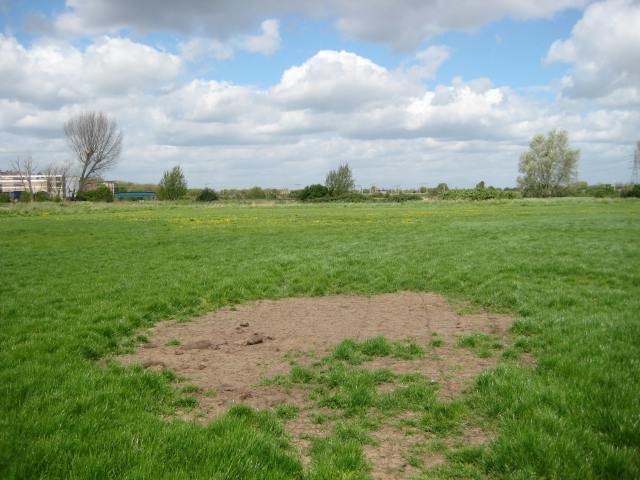
This Application is for the entire area of the former long-established Par-3 Golf Course, which closed “temporarily” last year for the duration of the Olympics but never reinstated and ready to be re-opened on 31st March 2013 as “promised” by the Lee Valley Regional Park Authority. The entire area is designated as Metropolitan Open Land and is situated adjacent to a Nature Reserve (the former Essex Filter Beds 2&3 site).
The Application is for the entire area, it is for full planning permission, and it is not time-limited. (The LVRPA have falsely publicly claimed – included in writing, in a recently-published letter from Mr. Stephen Wilkinson of the LVRPA to the local ‘WF Guardian’ newspaper – that the Application is only for part of the area immediately behind the Visitors’ Centre, that the use would be for a temporary period of time initially, and that the initial planning Application is for five years “to see how it goes” – all of which statements are blatantly untrue, and you will note that I am copying this letter, as a courtesy, to Mr. Wilkinson as I am not afraid to say so)
The truth is that this Application represents a complete change of use of this area. The entire Golf Course area would cease to be public open space, and would instead become a private campsite from which ordinary members of the public, including local residents, would be excluded. The proposed campsite use would be aimed at short-term visitors and holidaymakers and thus of no value to the local population. This development would be of no obvious benefit to Waltham Forest or its residents, either recreationally or financially. The disbenefits in terms of loss of open recreational space, however, are very clear.
The aim seems to be to provide a facility similar to the Regional Park Authority’s “camp-site” at Dobb’s Weir, which is essentially in fact a trailer park rather than a holiday campsite, full of trailer homes. That seems to be the ultimate intention here, with perhaps a few wooden “pixie-hut” (Mr Wilkinson’s phrase) holiday chalets, as well as the stated toilets, ablution blocks, and pitches for privately-owned touring caravans (and the cars and trucks that tow them), camper vans, motor-homes, winnebagos and large nylon tents. It is a disaster in the making and would look absolutely horrendous!
This proposal would, of course, require a large amount of fencing, and there doesn’t seem to be anything in the Application about what type of fencing is being proposed. Whatever is used, however, the area would become covered in fences and would look more like a prison camp than an open marshland meadow, completely destroying the semi-rural feel of the area and causing unacceptable loss of “openness” – which is completely contrary to the Metropolitan Open Spaces policy of Chapter 7 of the London Plan.
In short, to allow this to go ahead would entail unacceptable loss of local amenity space and unacceptable loss of publicly accessible Metropolitan Open Space, particularly in an area where MOL within the Regional Park is already severely adversely affected by over-development in and around it and where development pressure on open land is seriously eroding, urbanising and encroaching on what little precious green open space we have left (the land on Leyton Marshes where the freight road (Orient Way) runs was until 2001 a Grade I Site of Ecological Importance, but is now a noisy road, railway sidings and distribution warehousing, for example). This is completely contrary to the policies of the Borough’s Local Development Framework and the London Plan 2011.
I do not know if the Town and Country Planning Act 1990 is still in force, but if it is, then section 336 defines open space as “any land laid out as a garden or used for the purposes of public recreation.” Land that is enclosed but is being used for public recreation can be defined as open space, but where entry is denied to the general public, then the use cannot be counted as public open space. Thus, this – like the allotments “temporarily” transferred from LB Newham to Leyton Marshes – represents an overall loss of public open space, with no compensation, mitigation or exchange land in the immediate area being proposed. and Furthermore this loss of amenity would have no benefit for local people, but many disbenefits
It might also be pointed out that provision of sites for temporary accommodation, particularly where this is a permanent year-round use (as is being applied for), is not generally recognised as being a means of encouraging recreation, which the Regional Park was set up to facilitate, and in this case would certainly not be public recreation. Indeed the Park Authority have stated publicly that their main aim is to provide short-term accommodation for people attending pop concerts in the Olympic Park area. Massive pop concerts in Olympic venues were not, I suggest, quite the sort of recreational activity that those who drafted the Lee Valley Regional Park Act had in mind for London’s Green Lung!
The site would require a licence, and would require a team of security staff to ensure that members of the public, including local residents, are kept out. Such a development should not be permitted on land that has always been open and free for people to walk across and wander in – and which since 1905 has been guaranteed as public open space.
This development would inevitably mean severe negative impact upon the open character of the Leyton and Hackney Marshes area, although this is something one would have thought the LVRPA would be charged with preserving – particularly as their own “Park Development Framework” (PDF) calls for major improvements to landscape quality as a whole, ‘especially to the south of Lea Bridge Road and adjacent to the industrial areas along the eastern edge of the area’ so as to ‘better integrate these areas into the wider valley landscape.’ There are no proposals in this Application that would enhance landscape quality or make any improvements at all. The Application runs completely contrary to the Regional Park Authority’s own ‘Park Development Framework,’ which it seems the Park Authority have little regard to but which the Borough of Waltham Forest is obliged to have regard in reaching a planning decision.
The reason the LVRPA wanted to close the Golf Course down, according to Mr. Wilkinson, is that it was losing money. This is not in fact the case. The present manager of the Golf Course has told me that it makes money, but that the profit is hypothecated to the maintenance and upkeep of the Golf Course itself and of the adjacent Waterworks Nature Reserve across the flood relief channel at EFB 1&2. What the LVRPA want to do is make more money than is required to run the Nature Reserve, and use that profit in some unidentified way which may or (more likely) may not be of any benefit to the local residents of Waltham Forest and Hackney. That does not equate to a “major improvement to landscape quality” to the south of Lea Bridge Road. In fact, the opposite.
The Borough of Waltham Forest, as a riparian borough, has an obligation under the Lee Valley Regional Park Act 1966 to have regard to the provisions of the Act and the Park Plans which are produced under it. If this Application were granted permission it would result in an immense loss of local recreational amenity, loss of landscape quality, loss of visual amenity and loss of a valuable wildlife resource (has anyone warned the white ferrets what could be about to happen to their home?). Waltham Forest therefore MUST refuse permission, as this Application is clearly contrary to the stated aims of the Regional Park Authority’s own Park Plan.
There would also be an enormous negative impact on this area as Metropolitan Open Land. Regarding Green Belt and Metropolitan Open Land, in Chapter 7 (London’s Living Spaces and Places) the London Plan (2011) lays out strategies and policies for achieving “A city which delights the senses and … which makes the most of and extends its wealth of open spaces … realising their potential for improving Londoners’ health, welfare and development.”
The present proposal is in the first place contrary to the Neighbourhood Strategies which inform Chapter 7 of the London Plan, that “neighbourhoods should … provide a character that it is easy to understand and relate to,” and continues: “Development should be designed [to] improve people’s access to social and community infrastructure (including open spaces);” “Places of work and leisure, streets, neighbourhoods, parks and open spaces should be designed to meet the needs of the community at all stages of people’s lives.”
There is absolutely no sense in which the fencing off of open meadowland to be used as a trailer park and campsite for people from outside the area can be claimed to “extend [London’s wealth of] open spaces,” nor be “designed to meet the needs of the community.”
Nor does the proposal enhance the perception of contiguity of Leyton Marshes as an interconnected whole. Indeed, by fencing the area into discrete parcels bisected by rights of way corralled through fences, it would remove any sense of even being a part of Leyton Marshes.
At present, most of the Marshes in Hackney and Waltham Forest remain intact, coherent, connected and legible, but Leyton Marshes historically have suffered from extreme physical severance. Already crossed by railway sidings, the former Essex Filtering Beds and the Lea Bridge Road, it is becoming increasingly hard to mentally connect the Lammas Lands at Marsh Lane Fields as being an integral part of the same single marshland as Porter’s Field, where the Lea Valley Riding Centre is situated, let alone the Golf Course which lies between them cut off by the bulk of the ugly Visitors’ Centre and an old-fashioned railway crossing bridge. Leyton Marshes do not at present possess “a character that it is easy to understand and relate to” but it is surly the aspiration of the London Plan and indeed the Regional Park Authority’s own Park Development Framework for the Lea Bridge Area that this should be the underlying principle of any development or environmental improvement in this area.
Policy 7.4 (Local Character) of The London Plan states: “ Development should have regard to the form, function and structure of an area … it should improve an area’s visual or physical connection with natural features” (7.4A); and: “… open spaces should provide a high quality design response that … is informed by the surrounding historic environment.” (7.4Be). This Application clearly is for a development that would be entirely contrary to this, in that it has no regard to the area’s function as open recreational space and would ruin all perception of both the visual and physical connectivity of the site with the rest of Leyton and Hackney Marshes. And as a landscape historian, I have to say that the last thing on the LVRPA’s mind in this case would seem to be the surrounding historic environment of the Lea Valley marshlands in Leyton and Hackney.
Policy 7.17 (Metropolitan Open Land) of the London Plan states: “The Mayor strongly supports the current extent of Metropolitan Open land (MOL), its extension in certain circumstances and its protection from inappropriate development having an adverse impact on the openness of MOL” (7.17A); and states that, in regard to Planning decisions: “The strongest protection should be given to London’s Metropolitan Open Land and inappropriate development refused, except in very special circumstances, giving the same level of protection as in the Green Belt. Essential ancillary facilities for appropriate uses will only be acceptable where they maintain the openness of MOL” (7.17B). It is impossible to grant permission for this development whilst maintaining adherence to this policy of the London Plan. Therefore this Application MUST be refused.
The use of this area as a campsite or trailer park is completely unacceptable. Basildon Council recently spent millions of pounds evicting several families of Travellers from land they had been living on for decades at Dale Farm near Wickford, Essex because it was Green Belt Land (which the London Plan states is equivalent to Metropolitan Open Land), even though it had not been a green open space previously; how can that be the case there and yet the LVRPA think it is okay to encourage people to come to Leyton Marshes and put the same sort of structures on our open meadowland here? Surely this must represent “inappropriate development,” which the London Plan states clearly in Policy 7.17B should be refused?
The Borough of Waltham Forest has a duty to its residents to maintain our rights of free access to all of the Lea Valley Marshes as open land, a duty to have regard to the Park Plan (Park Development Framework), an obligation to implement the policies of the London Plan and an obligation to act within its own LDF.
This Application is quite clearly completely CONTRARY to all four of these legal duties and therefore MUST be refused planning permission.
2) Loss of open space for more Paddocking associated with the Riding Centre (‘Horse Hotel’)
The LVRPA has recently also put forward a Planning Application (2013/0410) for yet more private livery stabling on their already over-intensely built up “riding school” – where the horses and ponies are already seriously cramped for space. In my letter of objection, sent to your colleague Mr. John Harrison last month, I wrote: “this represents yet further over-intensification of use, yet more horses on the area, and … would inevitably lead to pressure to enclose yet more public open space on the Marshes to cope with the increased number of horses and ponies being kept in the stable-yard. That would be of immense disbenefit to local residents, with absolutely no advantage to Waltham Forest or its inhabitants.”
The Application for more paddocking, this time on the former Golf Course area south of the Waterworks Visitors’ Centre, was submitted the following day!
The proposed paddocking raises a number of issues; primarily the health and well-being of the horses which would be left out in the open all day every day in all weathers, with no warmth or shelter. This, in my view, amounts to neglect and possibly cruelty. No doubt if permission is given for yet more land to be fenced off, this time for paddocks, the LVRPA will cite this as a reason for having to build stabling, in the interests of horse welfare! And then here we go again, the Park has been granted an inch but it takes a mile and soon instead of a camp-site the area will be covered in horse-paddocks and stables for which the Park will claim the need for “ancillary structures” and say it does not need planning permission, just as its lawyers claimed the same in relation to the illegal stables in Leyton and the illegally-occupied meadowland on Walthamstow Marshes which the Lee Valley Riding Centre “squatted” in around 1992 (and continue to use, without any planning permission). To give permission for this present Application would set a dangerous precedent.
The Riding Centre is as intensively used as it could possibly get; yet the LVRPA have applied for yet more private livery stabling there. There are already far too many animals on the site to be comfortably housed and properly exercised in the limited space available to them. The British Horse Society visits once per year to ensure that the horses are not being maltreated and that the stables are run to an acceptable standard, and the LVRPA claims that the Riding Centre’s standards are high, but over the years I have heard constant reports of concerns from local people and passers-by about the condition and well-being of horses there.
If the present planning Application for yet more livery accommodation for privately-owned horses is granted permission, then the LVRPA are going to have to fence off more of our open space to provide exercise facilities for the animals. They have designated the western portion of Porter’s Field as an “Events Area,” which suggests that there could be temporary gymkhanas and show-jumping arenas there, and the amenity grass ley that has been put in after the debacle of the basket-ball court would not be a suitable mix for horses. It seems quite obvious that this Application is looking for two uses on the Golf Course land, and that if permission is granted for the paddocking then inevitably a shelter and then stabling and then more of the same will follow.
At present a “mobile shelter” is being proposed, but it would be large enough only for one horse, and not the six or seven that are proposed to be put in this area. I do hope that before making any recommendations regarding the determination of this Application you will contact the RSPCA for their comments in regard to the welfare of the poor horses that would be put in the paddock.
We are too used to the LVRPA getting its way “through the back door” – they build stables, put in exercise facilities, put down exercise yard surfacing, all without permission – and when someone makes enough of a fuss that the Local Government Ombudsman gets involved and the Borough finally bestirs itself to tick them off, they simply apply for and are granted a retrospective Certificate of Lawfulness of Use. It is time for Waltham Forest’s Planning Officers to realise that the only way to stop the LVRPA getting what it wants all the time is to nip suggestions like the present one smartly in the bud. Please turn this Application down!
I suggest that this part of the Application requires a separate Planning Application to be put forward. The Park Authority are asking for a campsite use and a pony-trekking use over the same parcel of land – these are two separate Applications for the same piece of land and to include them both together seems to me to be merely a way of avoiding paying the fee for lodging a further Planning Application.
3. Yet more fencing to keep us off our own land
The Park are essentially privatising land that has always belonged to the people of Walthamstow and Leyton and are increasingly fencing us out with barbed wire and electrified fencing. This is not the action of a Regional Park, it is the action of a greedy landowner.
There are Rights of Way through the Golf Course, and effectively members of the public – including the many cyclists and the cross-country running clubs who use the route – would be corralled into using these as penned-in corridors between the inevitable fencing that would split what is currently a large open grassland meadow into three separate areas, each fenced off and none of them open to the public. This sense of being literally fenced in could well be perceived by many local people as threatening and would also sadly increase the sense of the isolation of this part of Leyton Marshes from the rest (Porter’s Field and Marsh Lane Fields, as they have historically come to be known).
Mr. Wilkinson’s letter to the ‘WF Guardian’ stated that the path linking the Golf Course to the Friends Bridge access across the tidal (“Old”) River Lea to Hackney Marshes would remain open; however, this is a permissive path which does not belong to the LVRPA, and it is not in his gift to give such assurances.
This loss of access and loss of openness is absolutely unacceptable, and completely contrary to the London Plan’s policies relating to Metropolitan Open Land.
4. Ecological impacts on habitats and biodiversity
The LVRPA’s own Park Development Framework states plainly that the Park Authority will: “protect, enhance and manage the River Lee Navigation and River Lea and associated waterside environment along the western boundary of this area as wildlife corridors interconnected with the wider ecological resource on Walthamstow Marshes and Middlesex Filter Beds.” The Golf Course area was a key site identified for the implementation of this policy, yet there are no proposals in the Application to protect, let alone enhance, the adjacent waterside habitats.
The Park Development Framework states: “Landscape improvements should support and be sensitive to the biodiversity of key sites and heritage assets and aim to strengthen the river valley corridor and its associated waterways, maintaining and creating views out, to and from the valley.” Maybe they should – and someone needs to point out forcefully to the LVRPA that high mesh fences, touring caravans, cars, camper vans, motor-homes, ‘Winnebagos’ and large tents will block the views across this currently open meadowland. The best way to let them know is to refuse permission for this dreadful Application.
Finally, it is outrageous that the LVRPA, before the Application has even been determined, has already begun advertising the campsite at the Waterworks Visitors’ Centre on its website and is actually inviting bookings for this summer! We are all aware that there has been a secret “Concordat” between LVRPA and LBWF (signed when the Park dropped its Judicial Review against the Borough over the Essex Wharf high-rise development adjacent to Leyton Marsh by Lea Bridge); but it is hard to believe that Waltham Forest could really have given an undertaking to take a lenient view of any and every development proposal the LVRPA comes up with, as surely that would be illegal? Yet the Regional Park Authority certainly seem to assume that this will definitely be passed, either by Officers or the Planning Committee.
Conclusion
This proposal represents an unacceptable over-intensification of use and is contrary to the London Plan and adopted planning policies, for the reasons that:
1) the proposed camp-site and caravan park is not an appropriate permanent use of MOL; and
2) the campsite would be visually intrusive, negatively impacting on the open character of the Leyton Marshes area as a whole; and
3) it would entail unacceptable loss of space Metropolitan Open Space, particularly in an area where MOL within the Regional Park is already severely adversely affected by over-development in and around it; and
4) The parcelling up and fencing off of what is presently public open space, to provide a campsite of no use to local people, is a great disbenefit and would result in unacceptable visual intrusion into the landscape and loss of openness of character; and
5) the proposed campsite is not contained within the Riding Centre’s development plan as envisaged in the recently-adopted ‘Park Development Framework,’ to which the Borough is obliged to have regard, and indeed runs contrary to the stated aims of the PDF; and
6) It is contrary to the Objectives and Policies of the London Plan (Chapter 7), in that:
a) it diminishes rather than extends Metropolitan Open Land; and
b) if fails to enhance the contiguity of character of the Lammas Lands on which it is situated; and
c) it does not in any way meet the needs of the local community, who have no requirement whatsoever for a trailer park or camp-site , but do need open spaces for health and leisure activities; and
7) It would result in the permanent loss of open recreational land and associated wildlife habitats, contrary to the Borough’s Local Development Framework and Biodiversity Action Plan.
I therefore urge you to determine that this proposal represents an unacceptable loss of public open space, and that it would lead to pressure for further fencing off of what is presently public open space.
I ask that you please therefore REFUSE PERMISSION under delegated powers, or at the very least recommend that the Application be refused.
Yours sincerely,
Katy Andrews, BA, MSc.